Having a herniated disc in your spine can make it hard to get around at home and at work. At Atrium Health Floyd and Harbin Clinic, we’ll locate the source of your pain and work with you through rest, physical therapy and other treatments to strengthen and stabilize your spine. You may work with an orthopedic doctor, a neurosurgeon, a therapist and other care providers to find relief from your pain.
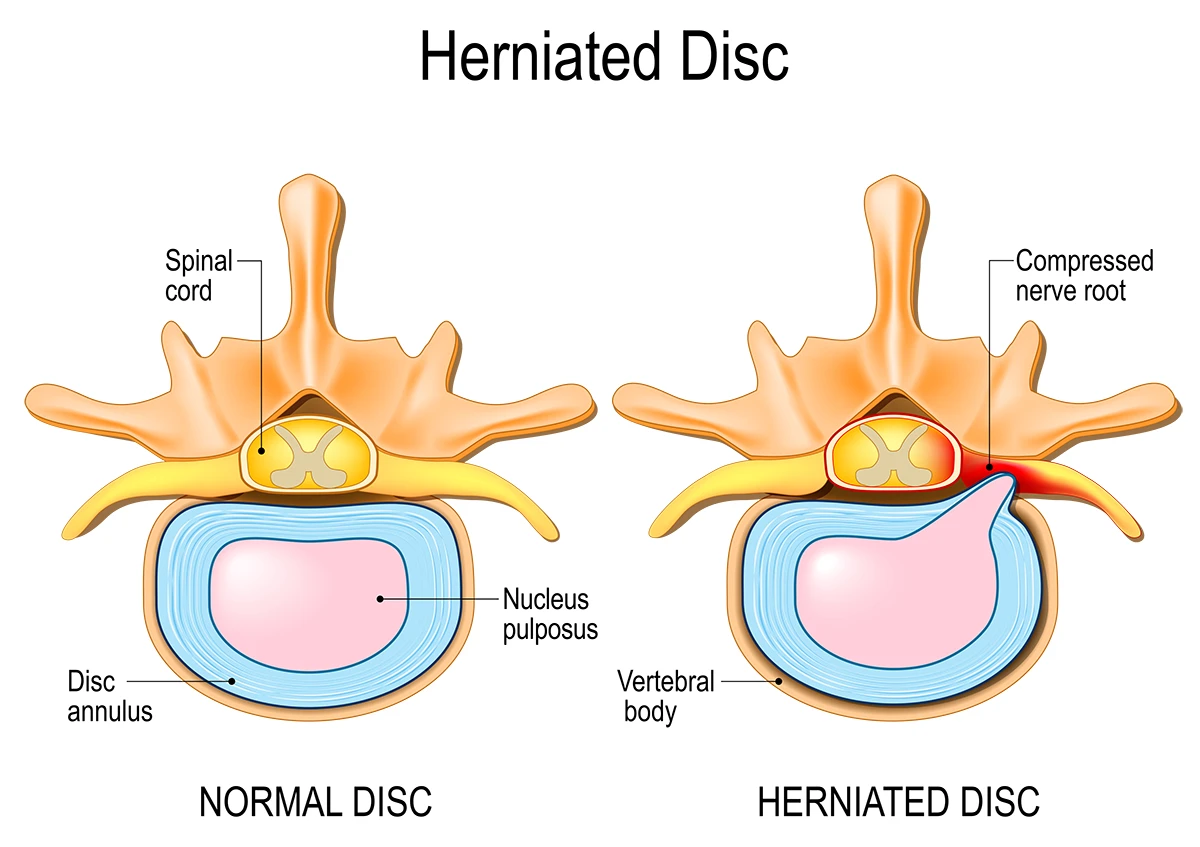
Image shows discs as seen from above. On the left is a healthy disc and on the right is a herniated disc.
What is a herniated disc?
The bones (vertebrae) of the spinal column protect nerves that come out of the brain and travel down your back to form the spinal cord. Large nerves branch out from the spinal cord at different spots depending on their function. They branch out between vertebrae.
The bones of your spine are separated by discs. These discs cushion the spinal column and put space between your vertebrae. The discs allow movement between the vertebrae, which lets you bend and reach.
When you have a herniated disc, the disc may bulge and move out of place because of an injury or strain. When this happens, there may be pressure on the spinal nerves in the area. This can lead to pain, numbness or weakness.
The lower back (lumbar area) of the spine is the most common area affected by a herniated disc. The neck (cervical) discs are the second most commonly affected area. The upper-to-mid-back (thoracic) discs are rarely involved.
Herniated discs occur more often in middle-aged and older men, usually after strenuous activity. Conditions present at birth that affect the size of the lumbar spinal canal may increase the risk of experiencing a herniated disc.
Symptoms of a herniated disc
Pain from a herniated disc most often occurs on only one side of your body. The pain often starts slowly and may get worse in these conditions:
- After standing or sitting
- At night
- When sneezing, coughing or laughing
- When bending backward or walking more than a few yards
You may also have weakness in certain muscles. Sometimes, you may not notice it until your doctor examines you. In other cases, you might notice you have a hard time lifting your leg or arm, standing on your toes on one side, squeezing tightly with one of your hands or other similar problems.
Symptoms of a lower back herniated disc
With an injured disc in your lower back, you may have sharp pain in one part of your leg, hip or buttocks and numbness in other parts. You may also feel pain or numbness on the back of the calf or the sole of the foot. The same leg may also feel weak.
Symptoms of a neck herniated disc
With an injured disc in your neck, you may have pain when moving your neck, deep pain near or over your shoulder blade or pain that moves to the upper arm, forearm and fingers. You can also have numbness along your shoulder, elbow, forearm and fingers.
The pain, numbness or weakness often goes away or improves eventually over weeks or months with rest or treatment.
Diagnosis of a herniated disc
The first step in diagnosing a herniated disc is undergoing a careful physical exam and providing your medical history. You’ll be asked to describe when and how the pain started. Depending on where you have potential herniated disc symptoms, your doctor examines your neck, shoulder, arms and hands or your lower back, hips, legs and feet.
Your doctor will check:
- For numbness or loss of feeling
- Your muscle reflexes, which may be slower or missing
- Your muscle strength, which may be weaker
- Your posture, or the way your spine curves
Your doctor may also ask you to:
- Sit, stand and walk. While you walk, your doctor may ask you to try walking on your toes and then your heels.
- Bend forward, backward and sideways
- Bend your head forward and to the sides while the health care provider puts slight downward pressure on the top of your head
- Move your neck forward, backward and sideways
- Raise your shoulders, elbow, wrist and hand and check your strength during these tasks
Diagnostic tests for herniated discs
Some diagnostic tests that may be recommended to help diagnose a herniated disc include:
- Electromyography (EMG) to determine the exact nerve root that is involved
- Myelogram to determine the size and location of disc herniation
- Nerve conduction velocity test
- Spine MRI or spine CT to show where the herniated disc is pressing on the spinal canal
A spine X-ray may be done to rule out other causes of back or neck pain; however, it’s not possible to diagnose a herniated disc with a spine X-ray alone.
Treatment for a herniated disc
The first treatment for a herniated disc is often a short period of rest with medicine for the pain. This is followed by physical therapy. Most people who follow these treatments recover and return to normal activities.
Your doctor may prescribe any of the following for pain:
- Nonsteroidal anti-inflammatory drugs (NSAIDs) for long-term pain control
- Narcotics if the pain is severe and does not respond to NSAIDs
- Medicine to calm the nerves
- Muscle relaxants to relieve back spasms
Steroid medicine injections near the herniated disc may also help control pain for several months. These injections reduce swelling around the disc and relieve many symptoms.
Your health care provider may also recommend a back brace to help support the spine. A brace can help prevent injuries in people who lift heavy objects often. But using these devices too much can weaken the muscles that support your spine and make the problem worse.
If you’re overweight, attaining a healthier weight may improve your herniated disc pain.
Physical therapy is important for nearly everyone with disc disease. Physical therapists teach you how to properly lift things, dress yourself, walk and perform other activities at home or at work. They teach you how to strengthen muscles that help support your spine and how to increase flexibility in your spine and legs.
Surgery for a herniated disc
Spine surgery may be an option if your symptoms do not go away with other treatments and time. Discectomy is surgery to remove all or part of a disc. Discuss with your doctor which treatment options are best for you.
Recovery from a herniated disc
Most people improve with treatment. But you may have long-term back pain even after treatment.
It may take several months to a year or more to go back to all your activities without having pain or straining your back. People who work in jobs that involve heavy lifting or back strain may need to change their job activities to avoid injuring their back again.
Neurology services
Personalized neurological care from experts you trust
Orthopedic services
Personalized orthopedic care from experts you trust
Get the MyAtriumHealth app
Get test results, message your provider & more.