Posterior cruciate ligament injury
Find a doctorThe posterior cruciate ligament (PCL) is one of several ligaments that keep your knee stable. The PCL helps keep your leg bones in place and allows your knee to move back and forth. It’s the strongest ligament in the knee. PCL tears often occur as a result of a severe knee injury.
A posterior cruciate ligament injury occurs when the ligament is stretched or torn. A partial PCL tear occurs when only part of the ligament is torn. A complete PCL tear occurs when the entire ligament is torn into two pieces.
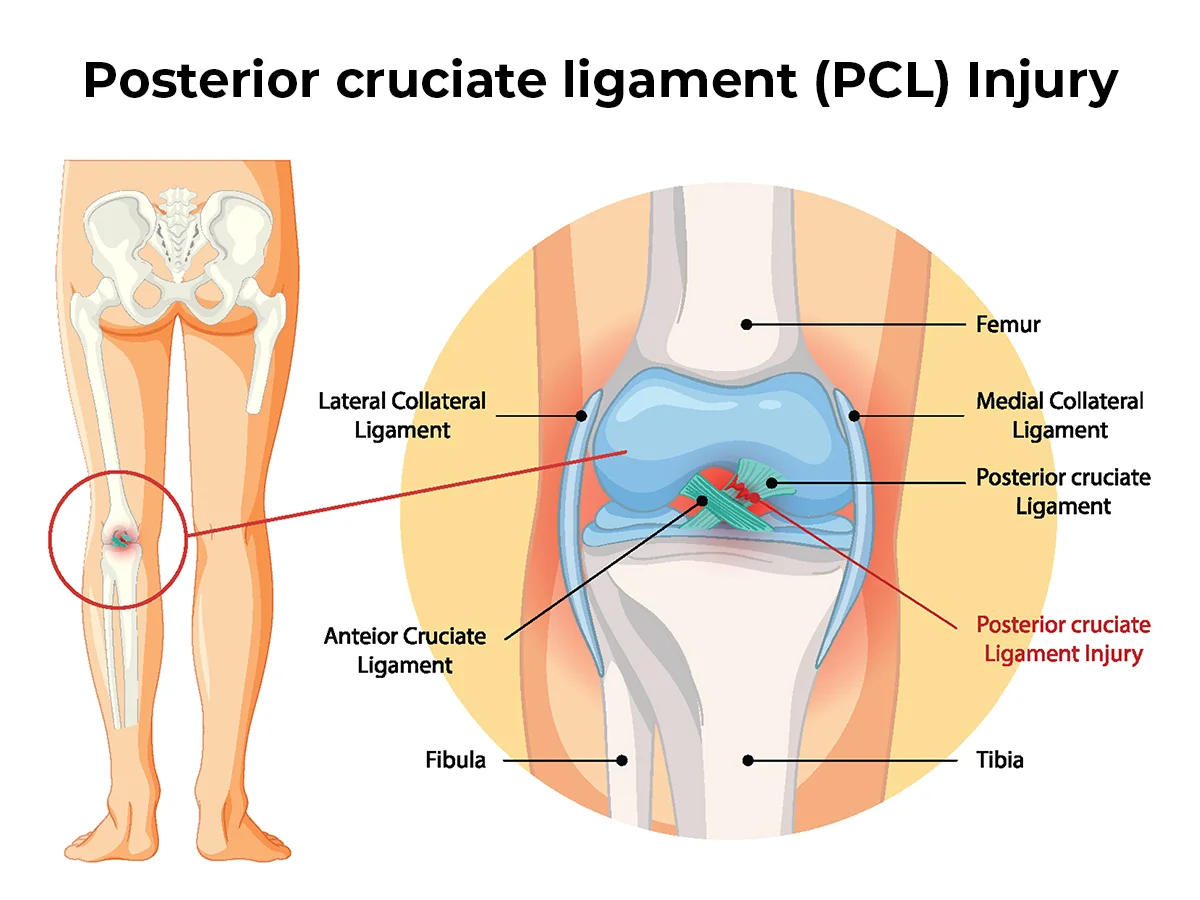
View of the many structures in a knee joint, with the PCL injury shown.
Causes of PCL injuries
Injuring the PCL takes a lot of force. It can occur if you:
- Get hit very hard on the front of your knee, such as hitting your knee on the dashboard during a car accident
- Fall hard on a bent knee
- Bend the knee too far backward (hyperflexion)
- Land the wrong way after jumping
- Dislocate your knee
PCL injuries commonly occur with other knee damage, including injuries to the nerves and blood vessels. Skiers and people who play basketball, football or soccer are more likely to have this type of injury.
Symptoms of posterior cruciate ligament injuries
With a PCL injury, you may have:
- Mild pain that may get worse over time
- An unstable knee that can shift as if it gives way
- Knee swelling that starts right after the injury
- Knee stiffness due to swelling
- Difficulty walking and going downstairs
Diagnosis of posterior cruciate ligament injuries
After examining your knee, the doctor may order these imaging tests:
- An MRI of the knee. An MRI machine takes special pictures of the tissues inside your knee. The pictures will show whether these tissues have been stretched or torn.
- X-rays to check for damage to the bones in your knee.
Treatment for posterior cruciate ligament injuries
If you have a posterior cruciate ligament injury, you may need:
- Crutches to walk until the swelling and pain get better
- A brace to support and stabilize your knee
- Physical therapy to help improve joint motion and leg strength
- Surgery to rebuild the PCL and possibly other tissues in the knee
If you have a severe injury, such as a knee dislocation, you’ll need knee surgery to repair the joint. For milder injuries, you may not need surgery. A lot of people can live and function normally with a torn PCL.
If you’re younger, having a torn PCL and instability of your knee may lead to arthritis as you age.
Talk with your doctor about the best treatment for you.
Orthopedic services
Personalized orthopedic care from experts you trust
Get the MyAtriumHealth app
Get test results, message your provider & more.