Heart valve disease
Find a doctorLearning of any heart condition can be scary and overwhelming, but the expert heart specialists at Atrium Health Floyd and Harbin Clinic can help diagnose and treat heart valve disease.
What is heart valve disease?
Heart valve disease is when any one or all of the heart’s four valves do not work properly due to damage or disease. The four valves of the heart are:
- Aortic
- Mitral
- Pulmonary
- Tricuspid
Causes of heart valve disease
Heart conditions and other disorders, age-related changes, rheumatic fever, or infections can cause acquired heart valve disease. These factors change the shape or flexibility of once-normal heart valves.
Congenital heart valve disease occurs before birth as the heart is forming, and the cause isn’t known. Congenital heart valve disease can occur alone or with other types of congenital heart defects.
Some conditions related to heart valve damage are:
- Advanced high blood pressure and heart failure can enlarge the heart or the main arteries.
- Atherosclerosis in the aorta, in which a waxy substance called plaque builds up inside the arteries. The aorta is the main artery that carries oxygen-rich blood to the body.
- Heart attack or heart injury can cause damage and create scar tissue, and may cause acquired heart valve disease.
- Autoimmune disorders such as lupus can affect the aortic and mitral valves.
- Carcinoid syndrome, which refers to carcinoid tumors in the digestive tract that spread to the liver or lymph nodes, can affect the tricuspid and pulmonary valves.
- Diet medicines have been linked to heart valve problems. These problems typically stabilize or improve after the medicine is stopped.
- Marfan syndrome is a congenital disorder, and it and other connective tissue disorders can affect the heart valves.
- Uncommon diseases and metabolic disorders, such as Fabry disease, and other metabolic disorders, such as high blood cholesterol, can also affect the heart valves.
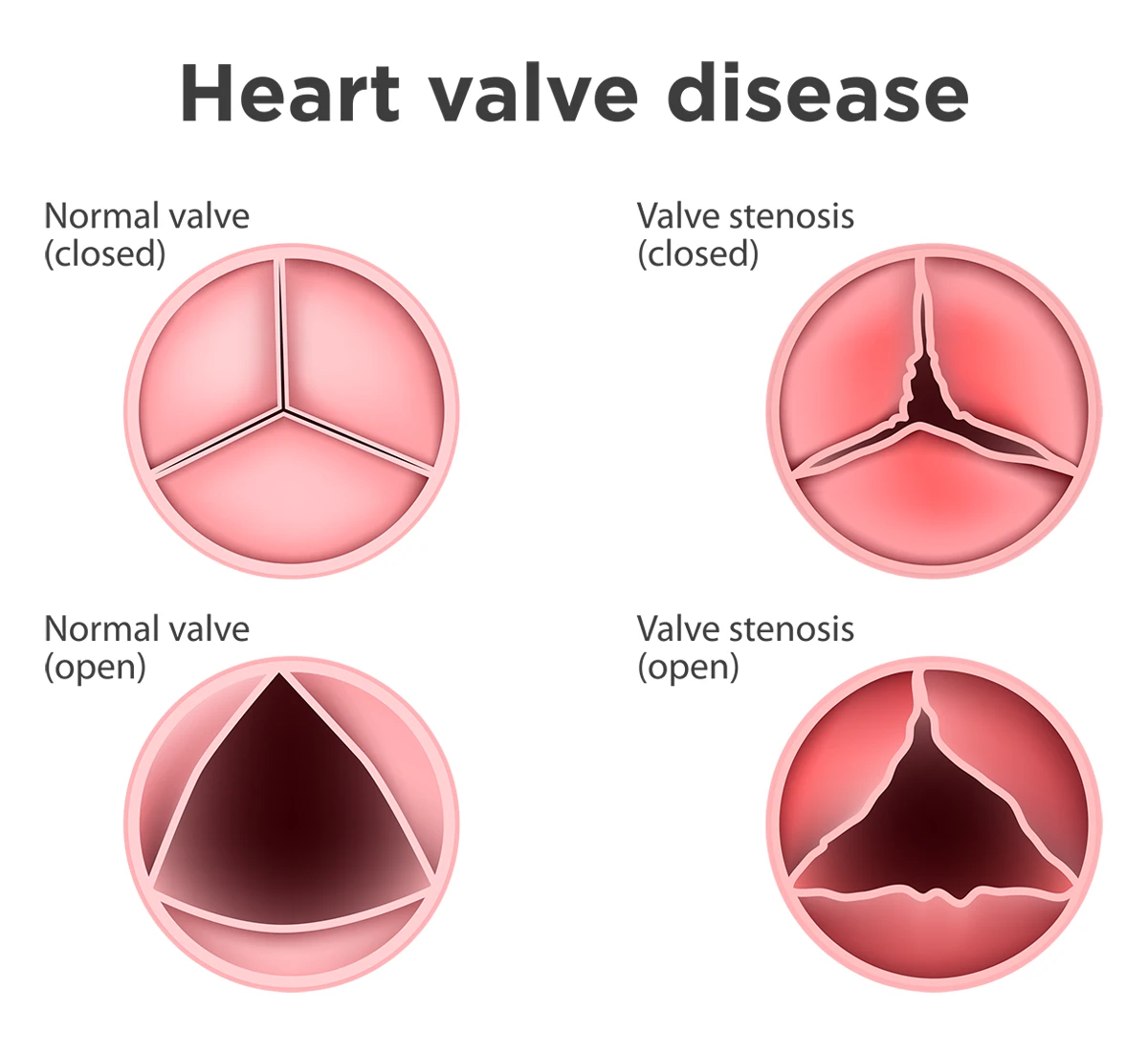
Illustration of stenosis, which is one type of heart valve disease. With stenosis, the valve thickens, stiffens or fuses with other tissue and can’t open or close all the way. This prevents blood from flowing properly.
Heart valve disease symptoms
The main sign of heart valve disease is an unusual heartbeat sound called a heart murmur, which can be heard with a stethoscope. However, many people have heart murmurs without having heart valve disease or any other heart problems. Others may have heart murmurs due to heart valve disease but have no other signs or symptoms.
Heart valve disease often worsens over time, so signs and symptoms may occur years after a heart murmur is first heard. Many people who have heart valve disease don’t have any symptoms until they’re middle-aged or older.
Other common signs and symptoms of heart valve disease relate to heart failure, including:
- Chest pain
- Dizziness or fainting
- Fatigue
- Fluttering, racing or irregular heartbeat
- Shortness of breath
- Swelling in your ankles, feet, legs, abdomen or veins in the neck
Heart valve disease diagnosis
Your primary care doctor may detect a heart murmur or other signs of heart valve disease. However, a cardiologist usually will diagnose the condition. To diagnose heart valve disease, your doctor will ask about your signs and symptoms and may perform a physical exam.
Physical exam
Your doctor will listen to your heart with a stethoscope. They’ll want to find out whether you have a heart murmur that’s likely caused by a heart valve problem.
Your doctor also will listen to your lungs as you breathe to check for fluid buildup. They’ll check for swollen ankles and other signs that your body is retaining water.
Tests and procedures
Echocardiography, or echo, is the main test for diagnosing heart valve disease. But an electrocardiogram (EKG) or chest X-ray is commonly used to reveal certain signs of the condition. If these signs are present, echo is usually done to confirm the diagnosis.
A doctor may also recommend other tests and procedures if there is a heart valve disease diagnosis. For example, you may have cardiac catheterization, stress testing or cardiac magnetic resonance imaging (MRI). These tests and procedures help your doctor plan treatment.
- Electrocardiogram (EKG) detects and records the heart’s electrical activity, including an irregular heartbeat, signs of a previous heart attack and whether the heart chambers are enlarged.
- Chest X-rays help establish which type of valve defect is present, how severe it is and whether there are any other heart problems
- Echocardiography uses sound waves to create a moving picture of your heart as it beats. Echo can show the size and shape of heart valves and chambers, how well the heart is pumping and whether a valve is narrow or has backflow.
- Cardiac catheterization allows a long, thin, flexible tube called a catheter to be threaded from a blood vessel in the arm, groin, or neck to reach the heart. Diagnostic tests and imaging performed via the catheter can show whether backflow is occurring through a valve and how fully the valve opens.
- Stress tests uses medicine or exercise to make the heart work harder and beat faster while tests and imaging are performed.
- Cardiac MRI uses a powerful magnet and radio waves to make detailed images of your heart and can confirm information about valve defects or provide more detailed information.
Heart valve disease treatment
To help treat heart conditions related to heart valve disease, your Atrium Health Floyd and Harbin Clinic doctor may advise you to make heart-healthy lifestyle changes, such as:
- Aiming for a healthy weight
- Heart-healthy eating
- Managing stress
- Physical activity
- Quitting smoking
Lifestyle changes and medicines can often treat symptoms successfully and delay problems for many years. While there is no cure heart valve disease, medicine can be used to:
- Lower blood pressure or cholesterol
- Prevent arrhythmias or irregular heartbeats
- Thin blood and prevent clots
- Reduce the heart’s workload
- Widen blood vessels and remove excess fluid
Repairing heart valves
Heart valves that cannot open fully (stenosis) can be repaired with surgery or with a less invasive catheter procedure called balloon valvuloplasty. During the procedure, the faulty valve in your heart is inflated to help widen the opening. Heart surgeons may also repair heart valves by:
- Adding tissue to patch holes or tears
- Removing or reshaping tissue
- Separating fused valve flaps
- Using cardiac catheterization
Replacing heart valves
Sometimes heart valves can’t be repaired and must be replaced with a synthetic or biological valve. Biological valves are made from pig, cow, or human heart tissue and last 10-15 years. Synthetic valves last longer than biological valves and usually don’t have to be replaced but require you to take blood-thinning medicines for the rest of your life. These medicines prevent blood clots, which can cause a heart attack or stroke. Synthetic valves also raise your risk of infective endocarditis.
Ross procedure
Doctors can also treat faulty aortic valves with the Ross procedure. Doctors removes the faulty aortic valve and replaces it with a pulmonary valve, and the pulmonary valve is then replaced with a pulmonary valve from a deceased human donor.
The Ross procedure may be especially useful for children because the surgically replaced valves continue to grow with the child and lifelong treatment with blood-thinning medicines isn’t required.
Transcatheter valve therapy
Interventional cardiologists perform procedures that involve threading clips or other devices to repair heart valves using a catheter. These surgeries are designed to stop the backflow of blood.
Doctors may also use a catheter to replace faulty aortic valves during a transcatheter aortic valve replacement (TAVR) procedure. A catheter is threaded to the heart where it expands a new valve so it fits securely within the old valve.
Heart services
Personalized heart care from experts you trust
Get the MyAtriumHealth app
Get test results, message your provider & more.