Rotator cuff injuries are painful experiences that can develop slowly or all at once. At Atrium Health Floyd and Harbin Clinic, we can help you manage your pain, identify the best treatment options or maybe even avoid injury altogether.
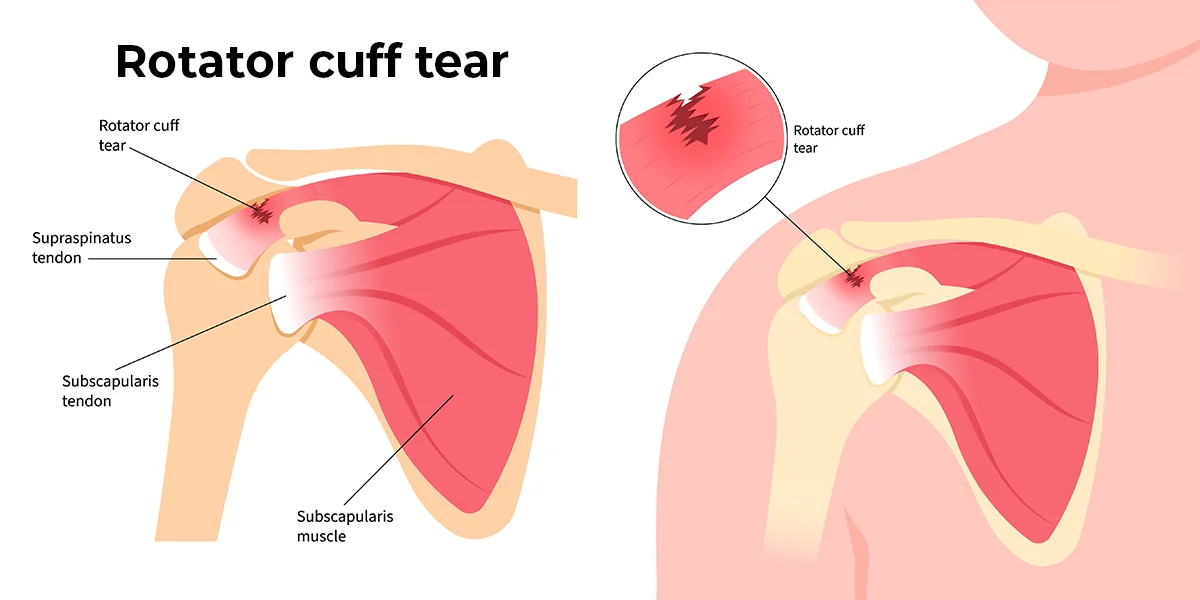
Muscle tears can happen suddenly or slowly over time.
What is a rotator cuff injury?
A rotator cuff injury is an injury to the muscles or tendons around the shoulder joint. Injuries to the rotator cuff include tendinitis, bursitis and rotator cuff tears. These injuries limit mobility of the arm through tightness or pain.
The shoulder joint is a ball-and-socket joint. The top part of the arm bone forms a joint with the shoulder blade. The rotator cuff holds the head of the arm bone into the shoulder blade. It also controls movement of the shoulder joint.
What causes a rotator cuff injury?
Rotator cuff tears or injuries may occur suddenly (acute) or over time (chronic) and can be a result of swelling.
- Acute tears can happen during a fall or be caused by a fast, jerking motion.
- Chronic tears occur slowly over time. At some point, the tendon wears down and tears. Chronic tendinitis or impingement syndrome makes this more likely.
Inflammation of the rotator cuff
The tendons of the rotator cuff pass underneath a bony area on their way to attaching to the top part of the arm bone. When these tendons are inflamed, they can become frayed over this area during shoulder movements. Inflammation of the rotator cuff can occur from overuse or from repeated use over a long period.
This swelling around the tendons is called tendinitis or impingement syndrome. Swelling of the fluid-filled sac cushioning the shoulder, called the bursa, results in a condition known as bursitis.
What are the symptoms of a rotator cuff injury?
The pain with a sudden tear after a fall or injury is usually intense. It may be hard to move your shoulder or raise your arm. Right after the injury, shoulder and arm weakness is common, as is a snapping sensation.
A chronic tear is less pronounced in the beginning, and pain, weakness, and stiffness or loss of motion worsen slowly over time. Eventually, the symptoms worsen and are not relieved by medicine, rest or exercise.
Rotator cuff tendon tears often cause pain at night. During the day, the pain is often more tolerable and usually only hurts with certain movements.
How is a rotator cuff injury diagnosed?
Your doctor may use one or several of the following to diagnose a rotator cuff injury:
- Physical exam: A physical exam may reveal tenderness and weakness.
- Ultrasound: An ultrasound can show tears.
- MRI: An MRI can show swelling or tears.
- X-ray: An X-ray can show a bone spur or change in the position of the shoulder. It can also rule out other causes of shoulder pain, such as arthritis.
- Arthrogram: Your provider injects dye into the shoulder joint, then an X-ray, CT scan or MRI is used to take a picture of it. This is usually used when your doctor suspects a small rotator cuff tear.
Who is at risk for a rotator cuff injury?
Certain things can make injury to the rotator cuff more likely, including:
- Aging
- Keeping your arm in the same position for long periods of time
- Sleeping on the same arm each night
- Playing sports that require your arm to be moved overhead repeatedly
- Poor posture over many years
- Working with your arm overhead for sustained periods of time
Rotator cuff injury prevention
Avoid injury by avoiding repetitive overhead movements. Do exercises to strengthen shoulder and arm muscles and practice good posture to keep your rotator cuff tendons and muscles in their right positions
Rotator cuff injury treatment & repair
To repair the rotator cuff, the tendons are reattached to the bone. Small rivets are often used in this procedure. Sutures are attached to the rivets, which tie the tendon back to the bone.
Open repair of the rotator cuff
During open repair, a surgical incision is made and a large muscle (the deltoid) is gently moved out the way to do the surgery. Open repair is done for large or more complex tears.
Arthroscopy and rotator cuff repair
During arthroscopy, the arthroscope is inserted through small incision. The scope is connected to a video monitor so the surgeon can view the inside of the shoulder. One to three additional small incisions are made to allow other instruments to be inserted.
Mini-open repair
During mini-open repair, any damaged tissue or bone spurs are removed or repaired using an arthroscope. Then, during the open part of the surgery, a two- to three-inch incision is made to repair the rotator cuff.
Recovery following rotator cuff repair
Surgery to repair a torn rotator cuff is often successful in relieving shoulder pain, but strength might not always return. Rotator cuff repair also can require a long recovery period, especially if the tear was large.
Other things that help post-surgery:
- Avoiding or reducing activities that cause or worsen symptoms
- Ice
- Medicine, such as ibuprofen and naproxen, to help reduce swelling and pain
- Physical therapy to stretch and strengthen the shoulder muscles
Post-surgery complications for rotator cuff repair
Some rotator cuff tears may not fully heal. Stiffness, weakness, and chronic pain may still be present. In these cases, poorer results are more likely:
- The rotator cuff was already torn or weak before the injury
- The rotator cuff muscles have severely weakened before surgery
- The tear is large
- After-surgery exercise and instructions are not followed
- You’re 65 or older
- You’re a smoker
Orthopedic services
Personalized orthopedic care from experts you trust
Get the MyAtriumHealth app
Get test results, message your provider & more.